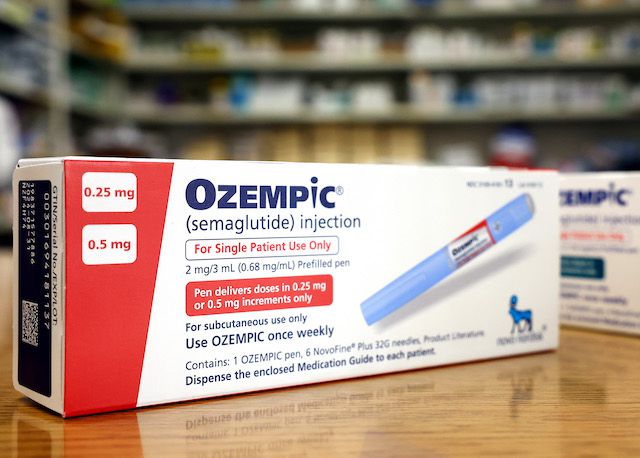
Zepbound and Ozempic are not the same drug — and they are not even approved for the same condition. Zepbound (tirzepatide) is FDA-approved for chronic weight management. Ozempic (semaglutide) is FDA-approved for type 2 diabetes only. Both are used for weight loss, but only one is approved for it.
On weight loss, Zepbound wins by a meaningful margin. The SURMOUNT-5 head-to-head trial showed tirzepatide produced 20.2% average weight loss vs 13.7% for semaglutide over 72 weeks. For a 220-pound person, that is the difference between losing 44 pounds and 30 pounds.
Where Ozempic has the edge: it has 8+ years of cardiovascular and kidney outcome data — a real clinical advantage for patients with established heart disease or diabetic kidney disease.
This guide compares Zepbound and Ozempic on weight loss results, cost, approved uses, side effects, and which to choose based on your health profile.
Key takeaways
- Zepbound (tirzepatide) averages 20.2% weight loss vs Ozempic (semaglutide) 13.7% in the SURMOUNT-5 head-to-head trial.
- Ozempic is not FDA-approved for weight loss. Using it for weight management is off-label.
- Zepbound is FDA-approved for chronic weight management and obstructive sleep apnea.
- Ozempic has 8+ years of cardiovascular outcome data from the SUSTAIN-6 and SELECT trials.
- Ozempic also has proven kidney protection data (FLOW trial).
- Both cost $25/month with commercial insurance and the manufacturer savings card.
- Without insurance: Zepbound starts at $299/month via LillyDirect vials vs Ozempic at ~$998/month retail.
- For pure weight loss, Zepbound is the stronger and FDA-approved choice.
- For type 2 diabetes with cardiovascular disease, Ozempic may be the clinically preferred option.
What is the difference between Zepbound and Ozempic?
The most important difference: they contain different drugs, made by different companies, approved for different uses.
| Zepbound | Ozempic | |
|---|---|---|
| Active ingredient | Tirzepatide | Semaglutide |
| Manufacturer | Eli Lilly | Novo Nordisk |
| FDA-approved for | Chronic weight management, OSA | Type 2 diabetes |
| Weight loss use | On-label | Off-label |
| Mechanism | GLP-1 + GIP receptor agonist | GLP-1 receptor agonist only |
| Max weekly dose | 15 mg | 2.0 mg |
| FDA approval year | November 2023 | December 2017 |
Zepbound is tirzepatide — a dual GLP-1 and GIP receptor agonist. It targets two appetite-control hormones simultaneously. Eli Lilly makes it.
Ozempic is semaglutide — a GLP-1 receptor agonist only. It targets one hormone pathway. The same drug at a higher dose is sold as Wegovy specifically for weight loss.
The dual mechanism is why Zepbound consistently outperforms Ozempic on weight loss. GLP-1 alone slows the stomach and reduces appetite. Adding GIP amplifies insulin sensitivity and increases energy expenditure — a second metabolic lever Ozempic doesn’t pull.
Zepbound vs Ozempic: weight loss comparison
This is the number that matters most for most patients.
Trial data at a glance
Zepbound / tirzepatide (SURMOUNT-1, 72 weeks, adults without diabetes):
- Average weight loss at 15 mg: 22.5%
- 91% lost ≥5% of body weight
- 49% lost ≥20%
Ozempic / semaglutide (off-label, based on STEP 1 and SUSTAIN data):
- At 2.0 mg (max dose): approximately 12–14% weight loss
- At 0.5–1.0 mg (typical diabetes doses): 4–7% weight loss
- Note: Ozempic’s weight loss data comes from diabetes trials, not obesity trials
SURMOUNT-5 — the only head-to-head trial (72 weeks):
- Tirzepatide vs semaglutide 2.4 mg (Wegovy dose, not standard Ozempic)
- Tirzepatide: 20.2% average weight loss
- Semaglutide: 13.7% average weight loss
- Gap: 6.5 percentage points — statistically significant
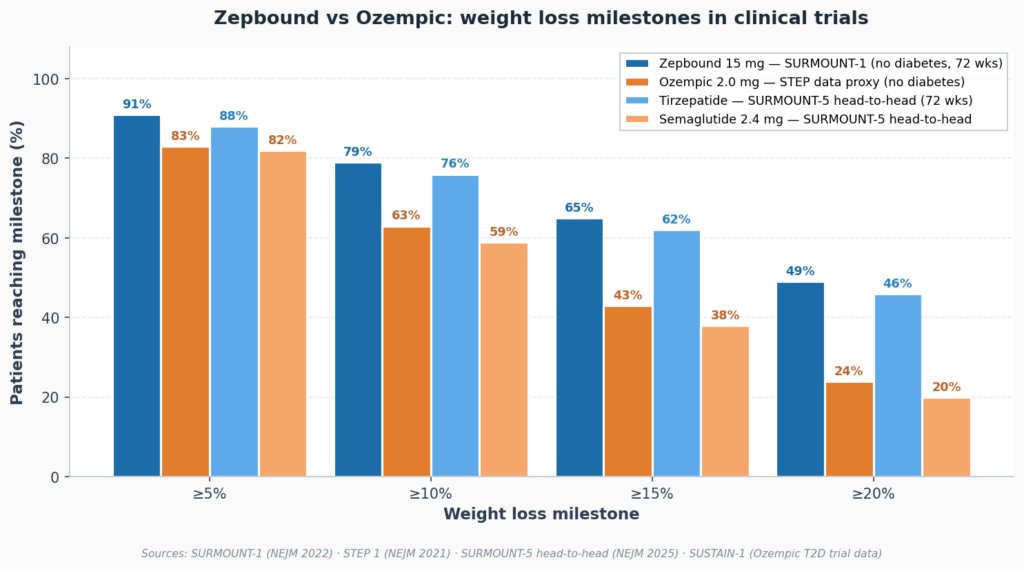
Figure 1. Zepbound vs Ozempic weight loss milestone comparison across individual trials and SURMOUNT-5 head-to-head. Sources: SURMOUNT-1 (NEJM 2022), STEP 1 (NEJM 2021), SURMOUNT-5 (NEJM 2025).
The chart highlights something important: the SURMOUNT-5 head-to-head used semaglutide at the Wegovy dose (2.4 mg) — higher than a typical Ozempic diabetes dose (0.5–2.0 mg). Standard Ozempic at diabetes doses would show an even wider gap versus Zepbound.
For a 220-pound patient:
- Tirzepatide at 20.2%: loses ~44 lbs
- Semaglutide at 13.7%: loses ~30 lbs
- Difference: approximately 14 lbs
Zepbound vs Ozempic cost in 2026
Self-pay pricing
| Zepbound | Ozempic | |
|---|---|---|
| Self-pay (lowest, no insurance) | $299/month via LillyDirect vials | ~$998/month retail |
| Self-pay (maintenance dose) | $449/month (7.5–15 mg) | ~$998/month |
| With savings card + commercial insurance | $25/month | $25/month |
| Medicare coverage | Not covered for weight loss | Covered for T2D |
Ozempic’s self-pay price is dramatically higher than Zepbound’s because Eli Lilly built a direct self-pay channel for Zepbound (LillyDirect vials at $299–$449/month). Ozempic has no equivalent cash-pay program — patients pay retail or use insurance.
Both drugs cost $25/month with commercial insurance and the manufacturer savings card. The savings card for each:
- Zepbound: see our Zepbound savings card guide
- Ozempic: NovoAssist savings program for eligible commercial patients
Neither card works with Medicare, Medicaid, TRICARE, or VA.
Insurance coverage differences
Ozempic has broader insurance coverage — most commercial plans and Medicare Part D cover it for type 2 diabetes. This is Ozempic’s practical advantage for patients with T2D who also want to lose weight.
Zepbound is covered by 60–65% of commercial plans for weight management, but faces more prior authorization hurdles. Medicare doesn’t cover it for weight loss.
If you have type 2 diabetes, Mounjaro (same drug as Zepbound, diabetes indication) may have better coverage than Zepbound for your situation. See our Mounjaro guide.
Zepbound vs Ozempic dosage comparison
The dosing schedules differ significantly because the drugs have different potencies per milligram.
Zepbound dosage schedule
| Weeks | Dose |
|---|---|
| 1–4 | 2.5 mg weekly |
| 5–8 | 5.0 mg weekly |
| 9–12 | 7.5 mg weekly |
| 13–16 | 10.0 mg weekly |
| 17–20 | 12.5 mg weekly |
| 21+ | 15.0 mg weekly (max) |
Ozempic dosage schedule
| Weeks | Dose | Primary use |
|---|---|---|
| 1–4 | 0.25 mg weekly | Starter (builds tolerance) |
| 5+ | 0.5 mg weekly | Typical T2D maintenance |
| After 4 weeks at 0.5 mg | 1.0 mg weekly | Most common diabetes dose |
| After 4 weeks at 1.0 mg | 2.0 mg weekly | Max dose (T2D and off-label weight loss) |
Ozempic doses look much smaller in milligrams than Zepbound’s — but they’re not comparable units. Semaglutide is far more potent per milligram than tirzepatide. At their respective max doses, both produce significant metabolic effects, just through different receptor pathways.
Side effects: Zepbound vs Ozempic
The side effect profiles overlap heavily because both drugs share the GLP-1 mechanism. GI effects dominate.
| Side effect | Zepbound (tirzepatide) | Ozempic (semaglutide) |
|---|---|---|
| Nausea | 24–33% | ~44% (STEP 1 at 2.4 mg) |
| Diarrhea | 17–22% | ~30% |
| Vomiting | 9–13% | ~24% |
| Constipation | 11–17% | ~24% |
| Injection site reactions | ~3% | ~6% |
| Discontinuation due to side effects | 6.2% | ~7% |
Ozempic shows higher GI reaction rates at equivalent therapeutic effect. This likely reflects semaglutide’s stronger gastric emptying delay via GLP-1 alone, without the counterbalancing metabolic effects of GIP.
Both drugs carry the same serious warnings:
- Thyroid C-cell tumor risk (animal studies; human relevance unknown)
- Contraindicated with personal or family history of medullary thyroid carcinoma (MTC) or MEN 2 syndrome
- Risk of pancreatitis, gallbladder disease, and acute kidney injury
- Not for use in pregnancy
Neither drug is categorically “harder to tolerate” — real-world discontinuation rates are similar.
Where Ozempic still has the advantage
Zepbound wins on weight loss. But Ozempic has genuine advantages that matter clinically for some patients.
8+ years of cardiovascular outcome data
The SUSTAIN-6 trial (2016) and the SELECT trial (2024, using Wegovy/semaglutide at higher dose) both confirmed semaglutide reduces major adverse cardiovascular events — heart attack, stroke, and cardiovascular death — in high-risk patients.
Tirzepatide’s cardiovascular outcomes trial (SURMOUNT-MMO) is still running. The data will come, but it isn’t here yet. For a patient with established coronary artery disease or recent heart attack, a prescribing physician may reasonably prefer semaglutide on this basis alone.
Proven kidney protection (FLOW trial)
The FLOW trial confirmed that semaglutide reduces the risk of kidney disease progression in people with type 2 diabetes and chronic kidney disease. In 2024, the FDA added a kidney protection indication to Ozempic.
Tirzepatide has no equivalent kidney outcome data yet. This is another clinically meaningful advantage for Ozempic in patients with both T2D and CKD.
Longer prescribing history and real-world data
Ozempic launched in December 2017. Zepbound launched in November 2023. Ozempic has six more years of real-world safety data across millions of patients, multiple ethnicities, and diverse clinical settings. Zepbound’s safety record is growing fast, but the depth of Ozempic’s post-market data is a legitimate factor for risk-averse prescribers.
Zepbound vs Ozempic: which is better for weight loss?
Zepbound is the stronger weight loss drug by the numbers. Every comparison — individual trials, head-to-head data, milestone rates — shows tirzepatide produces more weight loss than semaglutide at therapeutic doses.
If your primary goal is maximum weight loss and you don’t have type 2 diabetes, Zepbound is the correct FDA-approved choice. Ozempic is not approved for this use.
If you have type 2 diabetes and want weight loss alongside glycemic control:
- Zepbound (Mounjaro for the T2D indication) is likely more effective for both weight and HbA1c reduction.
- Ozempic is the better choice if you also have cardiovascular disease or chronic kidney disease, where the outcome data is much deeper.
Zepbound vs Ozempic for type 2 diabetes
Both drugs are used in type 2 diabetes, but only Ozempic has the diabetes FDA label for its weight-management formulation.
The SURPASS-2 trial compared tirzepatide directly to semaglutide 1.0 mg in T2D patients. Tirzepatide won on both outcomes:
- HbA1c reduction: tirzepatide −2.01% to −2.30% vs semaglutide −1.86%
- Weight loss: tirzepatide 7.8–11.2 kg vs semaglutide 5.7 kg
But for T2D patients with established cardiovascular disease or CKD, Ozempic’s proven outcomes data may outweigh the efficacy difference. This is a conversation to have with your provider — not a decision to make based on trial averages alone.
Can you switch from Ozempic to Zepbound?
Yes. If you’re on Ozempic and want to switch to Zepbound:
- Take your last Ozempic dose on your scheduled day.
- Start Zepbound 2.5 mg the following week.
- Titrate through the standard schedule: 2.5 → 5 → 7.5 → 10 → 12.5 → 15 mg, each dose for 4 weeks.
- Do not skip titration steps, even if you were on a high Ozempic dose. The drugs are different molecules and dose equivalence doesn’t transfer.
Common reasons to switch: better weight loss results, insurance coverage change, or a provider recommendation based on your health profile.
Always discuss with your prescribing provider before switching. Book a free Heally consultation if you want to talk through the switch with a licensed physician same-day.
Zepbound vs Ozempic: the honest summary
| Better choice | |
|---|---|
| Maximum weight loss | Zepbound |
| FDA-approved for weight loss | Zepbound (Ozempic is off-label) |
| Type 2 diabetes, no CV disease | Zepbound (Mounjaro label) |
| Type 2 diabetes + heart disease | Ozempic (SUSTAIN-6, SELECT data) |
| T2D + chronic kidney disease | Ozempic (FLOW trial) |
| Self-pay, no insurance | Zepbound ($299 vs ~$998/month) |
| Insurance coverage for T2D | Ozempic (broader Medicare/formulary) |
| Longest real-world safety record | Ozempic (2017 vs 2023) |
| Lower GI side effect rates | Zepbound |
Conclusion
Zepbound and Ozempic are both effective GLP-1 medications — but they are different drugs approved for different things. For weight loss, Zepbound is the stronger and FDA-appropriate choice, producing 20.2% vs 13.7% average weight loss in the first head-to-head trial. For type 2 diabetes patients with heart disease or kidney disease, Ozempic’s deeper outcome data gives prescribers a genuine clinical reason to choose it.
The right drug for you depends on your diagnosis, comorbidities, insurance coverage, and budget. Book a free consultation with Heally to talk through the options with a licensed provider — same-day telehealth appointments available in 40+ states, prescription delivered to your door.
FAQ
Is Zepbound better than Ozempic for weight loss?
Yes, by clinical trial data. The SURMOUNT-5 head-to-head trial showed tirzepatide (Zepbound) produced 20.2% average weight loss vs 13.7% for semaglutide over 72 weeks — a 6.5 percentage point gap. For a 220-pound patient, that’s roughly 14 extra pounds lost.
What is the difference between Zepbound and Ozempic?
Zepbound contains tirzepatide (a dual GLP-1 + GIP agonist, made by Eli Lilly) and is FDA-approved for weight loss. Ozempic contains semaglutide (a GLP-1 agonist only, made by Novo Nordisk) and is FDA-approved for type 2 diabetes. Using Ozempic for weight loss is off-label use.
Can you use Ozempic for weight loss?
Yes, but it’s off-label. Ozempic is FDA-approved for type 2 diabetes only. The same drug at a higher dose — semaglutide 2.4 mg branded as Wegovy — is FDA-approved for weight loss. Wegovy or Zepbound are the on-label choices for weight management.
How much does Ozempic cost vs Zepbound?
Without insurance, Ozempic retails at ~$998/month. Zepbound self-pay vials through LillyDirect start at $299/month for the starter dose. With commercial insurance and the manufacturer savings card, both cost as little as $25/month.
Which drug has better insurance coverage — Zepbound or Ozempic?
Ozempic has broader coverage for type 2 diabetes, including Medicare Part D. Zepbound is covered by 60–65% of commercial plans for weight loss, but faces more prior authorization requirements and is excluded from Medicare for weight management.
Can you switch from Ozempic to Zepbound?
Yes. Stop Ozempic on your scheduled injection day, then start Zepbound 2.5 mg the following week and titrate normally. Always re-titrate from the lowest dose — don’t try to match your Ozempic dose in milligrams, as the drugs have different potencies.
Does Ozempic have better heart protection than Zepbound?
For now, yes. Ozempic has 8+ years of cardiovascular outcome data including the SUSTAIN-6 and SELECT trials, which confirmed reduced risk of heart attack and stroke. Tirzepatide’s cardiovascular outcomes trial (SURMOUNT-MMO) is still running. This is a genuine clinical advantage for Ozempic in patients with established heart disease.
Is Zepbound or Ozempic better for type 2 diabetes?
Zepbound (via the Mounjaro label) produces greater HbA1c reduction and more weight loss in head-to-head T2D trials (SURPASS-2). But for T2D patients with cardiovascular disease or chronic kidney disease, Ozempic’s proven outcome data often makes it the preferred choice.
What are the side effects of Zepbound vs Ozempic?
Both cause nausea, diarrhea, vomiting, and constipation. Ozempic shows slightly higher rates of GI effects in trials (nausea ~44% vs ~24–33% for Zepbound). Discontinuation rates are similar: ~6–7% for both. Both carry the same thyroid tumor warning.
Related reading on Heally:
- Zepbound vs Wegovy: weight loss, cost, dosage and which is better
- How much does Zepbound cost in 2026? A complete pricing guide
- How to get tirzepatide with insurance: a complete 2026 guide
- Tirzepatide vs semaglutide: key differences and weight loss results
- Taking Ozempic to lose belly fat: what to expect in 2026
Sources
- Garvey WT et al. — SURMOUNT-5: tirzepatide vs semaglutide head-to-head weight loss trial (NEJM, 2025)
- Jastreboff AM et al. — Tirzepatide once weekly for obesity (SURMOUNT-1) (NEJM, 2022)
- Wilding JPH et al. — Once-weekly semaglutide in adults with overweight or obesity (STEP 1) (NEJM, 2021)
- Marso SP et al. — Semaglutide and cardiovascular outcomes in patients with type 2 diabetes (SUSTAIN-6) (NEJM, 2016)
- Lincoff AM et al. — Semaglutide and cardiovascular outcomes in obesity without diabetes (SELECT) (NEJM, 2023)
- Perkovic V et al. — Semaglutide and kidney outcomes in T2D and CKD (FLOW trial) (NEJM, 2024)
- Frías JP et al. — Tirzepatide vs semaglutide in T2D (SURPASS-2) (NEJM, 2021)
- FDA — Zepbound (tirzepatide) prescribing information
- FDA — Ozempic (semaglutide) prescribing information
- Eli Lilly — LillyDirect Zepbound self-pay pricing
Medical disclaimer: This article is for informational purposes only. Ozempic is FDA-approved for type 2 diabetes only — using it for weight loss is off-label. Always consult a licensed healthcare provider before starting, switching, or stopping any prescription medication. Individual results vary.