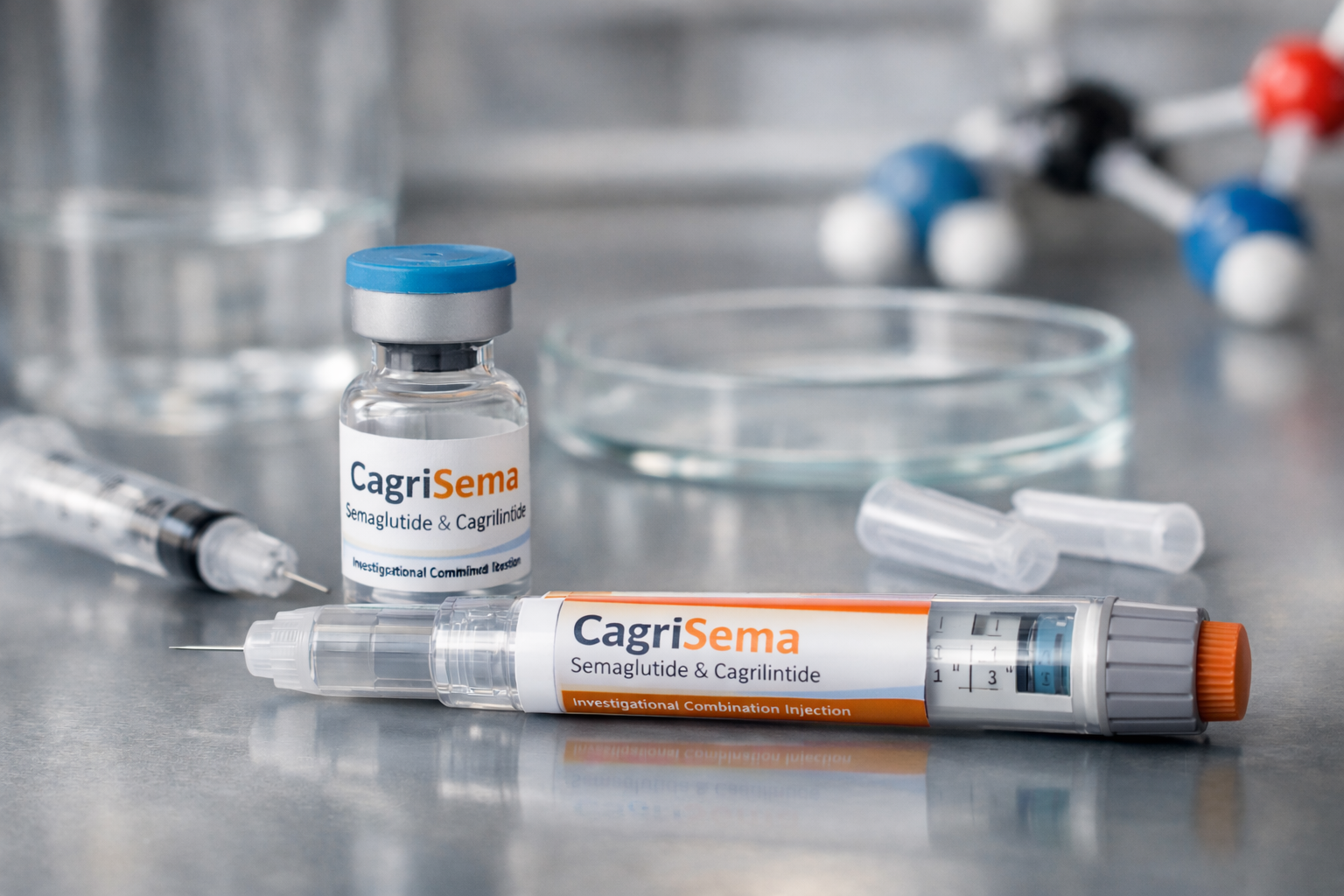
CagriSema is Novo Nordisk’s newest weight loss injection, a first-in-class combination of two drugs in one weekly shot: semaglutide 2.4 mg and cagrilintide 2.4 mg. In Phase 3 trials, it produced 22.7% average weight loss over 68 weeks, significantly more than semaglutide alone. Novo Nordisk filed for FDA approval in December 2025. A decision is expected in Q4 2026.
CagriSema is not yet available to patients. It is still investigational. This guide explains what CagriSema is, how it works, what the trials showed, and how it compares to Wegovy and Zepbound.
Key takeaways
- CagriSema combines semaglutide 2.4 mg (a GLP-1 agonist) and cagrilintide 2.4 mg (an amylin analogue) in a single weekly injection.
- It is the first drug to pair a GLP-1 receptor agonist with an amylin analogue for weight loss.
- REDEFINE-1 showed 22.7% average weight loss at 68 weeks — compared to 16.1% on semaglutide alone in the same trial.
- REDEFINE-4 showed 23.0% weight loss at 84 weeks head-to-head against tirzepatide (Zepbound), which produced 25.5%.
- Novo Nordisk filed the NDA with the FDA on December 18, 2025. FDA decision expected Q4 2026.
- Expected launch price: $1,400–$1,600 per month.
- CagriSema is not FDA-approved and not available outside clinical trials.
- Patients who qualify for weight loss treatment today can access semaglutide or tirzepatide now.
What is CagriSema?
CagriSema is a fixed-dose combination obesity medication made by Novo Nordisk, the same Danish company that makes Wegovy and Ozempic. Each weekly injection delivers two active drugs:
- Semaglutide 2.4 mg — a GLP-1 receptor agonist. This is the same active drug in Wegovy injection, already FDA-approved for weight loss since 2021.
- Cagrilintide 2.4 mg — a long-acting amylin analogue. This is a new compound not available as a standalone drug. Amylin is a gut hormone that the pancreas releases alongside insulin at mealtimes. It signals fullness and slows how fast the stomach empties.
Together, they work on two separate appetite-control systems at once — GLP-1 and amylin — which is why the combination outperforms either drug alone.
How does CagriSema work?
CagriSema targets appetite through two distinct hormonal pathways.
- The GLP-1 pathway (semaglutide’s role): GLP-1 (glucagon-like peptide-1) is a hormone released in the gut after eating. It tells the brain to reduce hunger, slows gastric emptying, and improves blood sugar control. Semaglutide mimics this hormone. This is the same mechanism behind Wegovy, Ozempic, and the Wegovy pill.
- The amylin pathway (cagrilintide’s role): Amylin is co-released with insulin when you eat. It reduces appetite through brain receptors separate from GLP-1, delays stomach emptying, and reduces post-meal blood sugar spikes. Cagrilintide mimics amylin. No currently approved weight loss drug uses this mechanism.
- Why the combination matters: In the REDEFINE-1 trial, semaglutide alone produced 16.1% weight loss and cagrilintide alone produced 11.8%. CagriSema produced 22.7% — more than either component and more than simply adding the two together would suggest. This synergy is the scientific rationale for the combination.
What did the clinical trials show?
Novo Nordisk ran the REDEFINE Phase 3 program to test CagriSema in adults with obesity. Three trials have reported results as of mid-2026.
REDEFINE-1: adults with obesity, no diabetes
Design: 3,417 adults with BMI ≥30 (or ≥27 with a comorbidity), without type 2 diabetes, for 68 weeks. Participants were randomized to CagriSema, semaglutide 2.4 mg alone, cagrilintide 2.4 mg alone, or placebo.
Results at 68 weeks:
| Group | Average weight loss |
|---|---|
| CagriSema | 22.7% (on-treatment) / 20.4% (all participants) |
| Semaglutide 2.4 mg alone | 16.1% (on-treatment) |
| Cagrilintide 2.4 mg alone | 11.8% (on-treatment) |
| Placebo | 2.3% |
- 40.4% of CagriSema participants lost 25% or more of their body weight
- 91.9% lost at least 5%
- Blood pressure fell by 10.9 mmHg systolic on average
- About 40% of participants reduced or stopped blood pressure medications
- 87.7% of those with prediabetes at baseline achieved normal blood sugar
Results were published in the New England Journal of Medicine and presented at the American Diabetes Association’s 2026 Scientific Sessions.
REDEFINE-2: adults with obesity and type 2 diabetes
Design: 1,206 adults with type 2 diabetes, for 68 weeks. CagriSema vs placebo.
Results:
- 15.7% average weight loss (all participants); higher for those who stayed on treatment
- HbA1c fell by 1.91 percentage points from a mean baseline of 8.2%
- 73.5% of participants reached HbA1c ≤6.5%, a normal blood sugar threshold
- Compared to 15.9% with placebo
Diabetes patients typically lose less weight on GLP-1 drugs than non-diabetic patients — this pattern holds with CagriSema.
REDEFINE-4: head-to-head vs tirzepatide
Design: 800 adults with obesity, CagriSema vs tirzepatide 15 mg (the max Zepbound dose), for 84 weeks.
Results:
- CagriSema: 23.0% average weight loss
- Tirzepatide: 25.5% average weight loss
- CagriSema did not meet the non-inferiority threshold — tirzepatide won by 2.5 percentage points
This is a meaningful result. CagriSema is highly effective, but tirzepatide (Zepbound) edges it out in a direct comparison. Novo Nordisk is planning a higher-dose version (CagriSema 2.4/7.2 mg, pairing standard cagrilintide with Wegovy HD-level semaglutide) in a new Phase 3 trial starting H2 2026.
Already taking Wegovy or Zepbound? Read our comparison of tirzepatide vs semaglutide to understand how current options stack up — and whether switching makes sense for you.
How CagriSema compares to approved GLP-1 drugs
| Drug | Mechanism | Average weight loss | FDA approved | Self-pay price |
|---|---|---|---|---|
| Wegovy injection (2.4 mg) | GLP-1 | 14.9% | Yes (2021) | ~$349/month |
| Wegovy HD (7.2 mg) | GLP-1 | 20.7% | Yes (March 2026) | ~$399/month |
| Zepbound / tirzepatide | GLP-1 + GIP | 22.5% | Yes (2023) | From $299/month |
| CagriSema | GLP-1 + amylin | 22.7% | No (NDA filed Dec 2025) | Est. $1,400–$1,600/month |
| Retatrutide | GLP-1 + GIP + Glucagon | 28.3% | No (NDA expected Q4 2026) | TBD |
CagriSema sits in tirzepatide’s efficacy range. Its key advantage over Wegovy is the dual mechanism — adding amylin on top of GLP-1. Its key disadvantage today is that it is not yet available. For a broader picture of where CagriSema fits, see our GLP-1 trends in 2026 guide.
Side effects of CagriSema
CagriSema’s side effects follow the same pattern as other GLP-1 drugs. Gastrointestinal effects are the most common, most prominent during dose escalation, and mostly mild to moderate.
From REDEFINE-1:
- Nausea: 55% of CagriSema participants vs 12.6% with placebo
- Constipation: 30.7% vs 11.6%
- Vomiting: 26.1% vs 4.1%
- Discontinuation rate: 5.9% vs 3.5% placebo — comparable to Wegovy (6.9%) and Zepbound (6.2%)
The nausea rate (55%) is higher than the ~40–45% typical for semaglutide alone. This reflects the combined slowing of gastric emptying through both GLP-1 and amylin pathways. However, most events were mild to moderate and clustered during the first weeks of dose escalation. Once patients reached the maintenance dose, GI side effects largely resolved.
Injection site reactions occurred in 10–15% of participants, slightly more than with semaglutide alone.
Expected contraindications will likely mirror existing semaglutide contraindications: personal or family history of medullary thyroid carcinoma (MTC), Multiple Endocrine Neoplasia type 2 (MEN 2), active pregnancy, or severe pancreatitis history.
CagriSema FDA approval timeline
Novo Nordisk submitted the New Drug Application (NDA) to the FDA on December 18, 2025, for chronic weight management in adults with obesity or overweight with a weight-related comorbidity.
Standard FDA review takes 10–12 months after a complete NDA submission. Based on the December 2025 filing, that puts a decision around October–December 2026. As of July 2026, no PDUFA (target action) date has been publicly confirmed.
If approved in Q4 2026, commercial launch would follow in early 2027 — allowing for manufacturing scale-up and pharmacy distribution setup.
Novo Nordisk has also submitted early regulatory filings in the EU through the European Medicines Agency (EMA). EU approval typically follows FDA approval by 3–6 months.
Who will be eligible for CagriSema?
Based on REDEFINE trial populations and the NDA submission terms, expected eligibility criteria are:
- BMI ≥30, or
- BMI ≥27 with at least one weight-related condition such as hypertension, dyslipidemia, type 2 diabetes, or obstructive sleep apnea
- Adults 18 years or older
- Not pregnant or breastfeeding
Contraindications will likely include: personal or family history of MTC or MEN 2 syndrome, prior serious allergic reaction to semaglutide or cagrilintide, and active pancreatitis.
How much will CagriSema cost?
No official list price has been set. Industry analysts project a launch price of $1,400–$1,600 per month at retail — consistent with current Wegovy and Zepbound list prices. Novo Nordisk will almost certainly launch with:
- A savings card for patients with commercial insurance (reducing costs to $25–$50/month in many cases)
- A patient assistance program for income-qualifying uninsured patients
- Possible direct-to-consumer pricing through NovoCare Pharmacy, similar to Wegovy’s $349/month self-pay model.
What should you do right now?
CagriSema will not reach pharmacies until at least early 2027. If you need weight loss support today, the most effective available options are:
- Wegovy HD (7.2 mg) — FDA-approved March 2026, producing 20.7% average weight loss. The best available semaglutide option right now.
- Zepbound / tirzepatide — FDA-approved since November 2023. Beat CagriSema head-to-head with 25.5% vs 23% weight loss. Available from $299/month.
- Wegovy pill — oral semaglutide, launched January 2026. No injections, starting at $149/month.
A licensed provider can compare your options and write a prescription. Book a free consultation with Heally — same-day telehealth appointments available in 40+ US states.
Conclusion
CagriSema is the most promising new weight loss injection in Novo Nordisk’s pipeline and one of the most effective investigational drugs in obesity medicine. By pairing semaglutide with a novel amylin analogue, it produced 22.7% average weight loss — significantly more than semaglutide alone and competitive with tirzepatide.
The REDEFINE-4 head-to-head result (23% vs 25.5% for tirzepatide) matters. CagriSema is excellent but not the clear winner over current options. Novo Nordisk knows this — the higher-dose 2.4/7.2 mg trial planned for H2 2026 is designed to close that gap.
FDA approval is expected in Q4 2026. Real patients should see it available in pharmacies by early-to-mid 2027. Until then, Wegovy HD, Zepbound, and the Wegovy pill are all available, proven, and accessible today through telehealth.
FAQ
What is CagriSema?
CagriSema is an investigational weight loss injection combining semaglutide 2.4 mg (a GLP-1 agonist, the drug in Wegovy) and cagrilintide 2.4 mg (an amylin analogue). It is made by Novo Nordisk and given once weekly. It is not yet FDA-approved.
How much weight can you lose on CagriSema?
In the REDEFINE-1 Phase 3 trial, people on CagriSema lost an average of 22.7% of their body weight over 68 weeks when accounting only for those who stayed on treatment. In the real-world metric (all participants), average weight loss was 20.4%. About 40% of participants lost 25% or more.
When will CagriSema be available?
Novo Nordisk filed for FDA approval on December 18, 2025. A decision is expected in Q4 2026 — approximately October to December. If approved on schedule, US patients could access it in early-to-mid 2027.
What is cagrilintide and how is it different from semaglutide?
Cagrilintide is a long-acting amylin analogue. Amylin is a hormone released after meals that signals fullness through separate brain pathways from GLP-1. Semaglutide mimics GLP-1. CagriSema uses both pathways together, which is why it outperforms either drug taken alone.
How does CagriSema compare to Wegovy and Zepbound?
CagriSema (22.7% weight loss) outperforms standard Wegovy injection (14.9%) and is competitive with Zepbound/tirzepatide. In a direct head-to-head trial (REDEFINE-4), tirzepatide edged CagriSema 25.5% to 23.0% at 84 weeks.
What are the side effects of CagriSema?
The most common side effects are gastrointestinal: nausea (55%), constipation (30.7%), and vomiting (26.1%). These are most pronounced during dose escalation and mostly mild to moderate. Discontinuation rates were 5.9% — comparable to Wegovy and Zepbound.
Will insurance cover CagriSema?
No official formulary decisions have been made. Once approved, coverage will likely follow the same rules as Wegovy — requiring BMI criteria, documentation, and prior authorization. Commercial plans with GLP-1 coverage should cover it. Medicare coverage may be available if CagriSema also gets approved for type 2 diabetes.
How much will CagriSema cost?
No official price has been set. Industry estimates project $1,400–$1,600 per month at list price, consistent with Wegovy and Zepbound. Novo Nordisk will likely offer savings cards and patient assistance programs at launch, similar to its existing Wegovy access programs.
Sources
- Novo Nordisk — NDA filing for CagriSema, December 18, 2025
- American Diabetes Association — REDEFINE-1 and REDEFINE-2 results, ADA 2026 Scientific Sessions
- HCPLive — REDEFINE-1 Phase 3 safety and efficacy data
- Clinical Trials Arena — REDEFINE-4: CagriSema vs tirzepatide head-to-head, February 2026
- Life Science Daily News — CagriSema FDA review timeline and NDA update, July 2026
- PharmExec — REDEFINE-1 results: CagriSema falls short of 25% weight loss target
- Drugs.com — CagriSema FDA approval status history
- New England Journal of Medicine — REDEFINE-1 full publication (presented at ADA 2026)
- Novo Nordisk — REIMAGINE Phase 3 diabetes trial results, ADA 2026 and The Lancet
- FDA — Wegovy (semaglutide) prescribing information, 2025
Related reading on Heally:
- What is Wegovy HD? A complete 2026 guide to the 7.2 mg semaglutide injection
- Tirzepatide vs semaglutide: key differences and weight loss results
- How much does Zepbound cost in 2026? A complete pricing guide
- 5 GLP-1 trends to expect in 2026
- Semaglutide dosing guidelines: a complete 2026 schedule
Medical disclaimer: CagriSema is an investigational drug. It is not FDA-approved and not available outside clinical trials. This article is for informational purposes only and does not replace medical advice. Always consult a licensed healthcare provider before starting, stopping, or changing any prescription medication.