


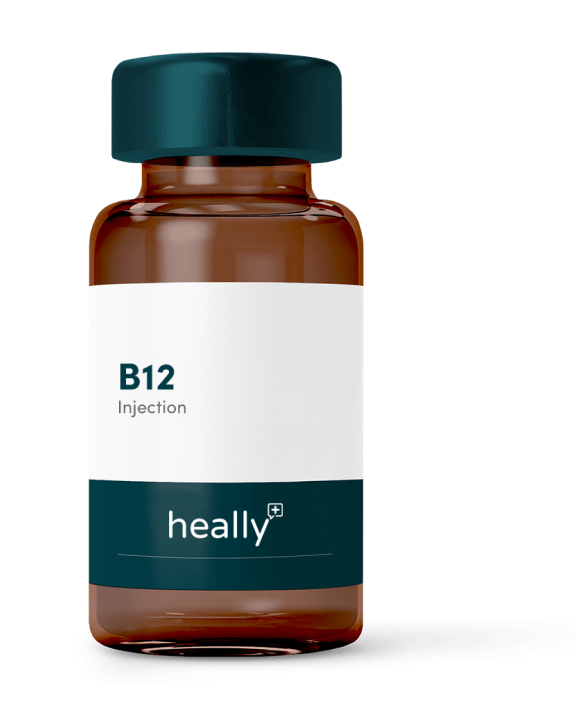
Get B12 Injection Online
A vitamin B12 injection delivers cyanocobalamin or methylcobalamin directly into the body, bypassing the digestive tract entirely. This matters because many adults with low B12, whether from dietary restriction, aging, or conditions like pernicious anemia, cannot absorb enough B12 through food or oral supplements alone. A licensed provider reviews your symptoms, history and labs online and decides whether a B12 injection is appropriate. If prescribed, it ships to your door.
FDA status: Cyanocobalamin injection is FDA-approved to treat vitamin B12 deficiency, including pernicious anemia. Methylcobalamin injection is a compounded drug that is not FDA-approved. B12 injections are not FDA-approved for energy, metabolism or weight loss.
B12 Injection Program from $85 /month
-
 Free consultation with Licensed providers in all 50 states
-
 Discreet home delivery





 Personalized support
 100% Online
 No hidden fees
 LegitScript-certified
 Discreet delivery
How to get a B12 injection prescription online
Getting your vitamin B12 injection through Heally is a straightforward three-step process.
Get your B12 prescriptionWho can benefit from B12 injections?
B12 injections are most appropriate for people with confirmed or suspected B12 deficiency. The following groups are the most common candidates.
B12 deficiency and fatigue
Fatigue can be a symptom of B12 deficiency. Treating a confirmed deficiency is the FDA-approved use; injections are not shown to raise energy in people with normal B12 levels.
B12 injections for neurological support
B12 is critical for maintaining the myelin sheath around nerve fibers. Deficiency can cause numbness, tingling, and cognitive fog. Restoring adequate levels through injections is a standard medical approach when oral absorption is impaired.
B12 shots and weight management
Vitamin B12 injections are not an FDA-approved treatment for weight loss. Claims of fat loss from B12 injections are not supported by clinical evidence.
B12 shots for malabsorption or dietary restriction
Vegans, vegetarians, older adults, and people with GI conditions (Crohn's disease, celiac disease, pernicious anemia) commonly have inadequate B12 absorption. Injections bypass the gut and are the standard treatment when absorption is impaired.
Who should check with a provider first
If you are pregnant, nursing, have kidney disease, or take medications that interact with B12 metabolism (such as metformin), discuss this with a provider before starting. The online visit screens for contraindications.

How to get a B12 injection online
Ready to begin? Book a free visit with a licensed provider who can evaluate your B12 status and write your prescription if it is clinically appropriate.
Book free consultation
What is the B12 Injection Cost?
- Free virtual visit to review your symptoms and labs
- Provider evaluation of your B12 status
- Your B12 injection prescription if clinically appropriate
- Discreet home delivery with self-administration guidance
- Ongoing refills and follow-ups online
Monthly pricing depends on the dose and form your provider prescribes. Vitamin B12 injections require a prescription and are used under provider supervision.
B12 injection vs oral supplement, which fits you?
A common question when addressing low B12 is whether an injection is actually necessary. Here is an honest comparison. Heally provides the injectable option by telehealth.
Delivered under the skin or into a muscle, bypassing the gut. First-line for pernicious anemia and malabsorption.
- Bioavailability: nearly 100%, bypasses GI absorption entirely
- Deficiency: first-line for pernicious anemia and malabsorption
- Dosing: weekly to monthly maintenance
- Prescription: yes, through Heally
- At home: yes, after provider guidance
Daily tablets or lozenges. Suitable only when your gut can still absorb B12 normally.
- Bioavailability: 1 to 2% absorbed passively without intrinsic factor
- Deficiency: only if GI absorption is intact
- Dosing: daily, high-dose oral
- Prescription: no, available OTC
- At home: yes
Get a B12 injection prescription
Not sure which format fits your situation? A licensed provider can review your labs and history during a quick online visit.
Talk to a provider
What is a B12 injection?
A B12 injection is a dose of vitamin B12 given either under the skin (subcutaneous, or subQ) or into a muscle (intramuscular, or IM). Both are referred to as vitamin B12 shots. The most common forms used are cyanocobalamin (stable, widely available) and methylcobalamin (a compounded form that is not FDA-approved).
Unlike oral B12, which depends on intrinsic factor and healthy gut absorption, the injection delivers B12 directly into the bloodstream. This makes it the preferred route when a patient cannot absorb B12 through the gastrointestinal tract.
Vitamin B12 injection dosage for adults
Your provider sets your dose based on the reason for treatment, your current blood levels, and the form prescribed. Standard medical dosing for confirmed deficiency typically involves an initial loading phase followed by maintenance.
- Loading phase (deficiency): 1000 mcg IM or subQ daily or every other day for 1 to 2 weeks
- Maintenance: 1000 mcg monthly is a standard maintenance dose for conditions like pernicious anemia
In ml: cyanocobalamin is typically supplied at 1000 mcg/ml, so a 1000 mcg dose equals 1 ml. Your prescription label specifies the exact volume. For deficiency, weekly injections are common during the loading phase, and monthly maintenance is standard long-term. Your provider determines the schedule based on your labs and response.
Always follow the instructions on your prescription label. Do not adjust your dose or frequency without speaking to your provider.
Do B12 shots work?
For people with confirmed vitamin deficiency, injectable B12 is a clinically well-established and effective treatment. It reliably raises serum B12 levels, resolves megaloblastic anemia, and, when started before irreversible damage, can reverse neurological symptoms.
For people without a deficiency, the evidence for additional benefit from injections is much weaker. If your B12 levels are already adequate, injecting more does not produce documented improvements in energy or cognition in clinical studies.
We present B12 injections as a treatment for confirmed deficiency, which is the FDA-approved use. Your provider will set realistic expectations based on your labs.
B12 injection at home, is it possible?
Yes. B12 injection at home is entirely feasible for both subcutaneous and intramuscular routes. Subcutaneous B12 injections are given under the skin, typically in the abdomen or outer thigh. IM injections go into muscle, most often the outer thigh (vastus lateralis) or deltoid. These are the standard B12 injection sites for self-administration.
Your provider walks you through technique during your consultation, and your prescription ships with clear instructions. A B12 self-injection pen is available as an option for patients who prefer it over a traditional syringe. If you searched for B12 injection near you, note that with Heally you can skip the clinic trip entirely and administer your doses at home on your schedule.
B12 injection side effects
Side effects are possible and may include:
- Injection site pain, redness, or swelling
- Mild itching
- Brief diarrhea (less common)
- A feeling of warmth after the injection
Allergic reactions to cyanocobalamin, including rare serious reactions, have been reported and require immediate medical attention. People with Leber hereditary optic neuropathy should not receive cyanocobalamin. Report anything persistent or severe to your provider, who monitors your response throughout treatment.
Meet the doctors behind your B12 care
Your B12 injection is evaluated and prescribed by board-certified physicians and licensed clinicians, each trained at respected U.S. medical institutions and licensed to practice in your state.
Dr. Vanessa Niles, M.D.
OB/GYN
Board-certified OB/GYN with 40+ years of experience in nutrition, hormone-related treatments, and wellness. Reviews B12 information for accuracy.
- M.D., Meharry Medical College
- 40+ years of clinical experience
Dr. Jason Hechtman, M.D.
Internal Medicine
Internal Medicine physician with 30+ years focused on metabolic health, nutrition, and deficiency management.
- M.D., Wayne State University
- 30+ years of clinical experience
Dr. Benjamin Krasne, M.D.
Metabolic Health
Board-certified physician specializing in metabolic health and nutritional wellness, with a focus on telemedicine.
- M.D., University of Miami
- Metabolic & nutritional medicine
Dr. Kimberlee Coleman, M.D.
Family Medicine
Board-certified Family Medicine physician with 20+ years in wellness, nutrition, and whole-person care.
- M.D., University of Kansas
- 20+ years of clinical experience
Dr. Zaman Javaheri, M.D.
Family Medicine
Physician with 20+ years in Family Medicine focused on nutrition, wellness, and whole-person health.
- M.D., Ross University
- 20+ years of clinical experience
Frequently Asked Questions about B12 Injections

This information was reviewed by Dr. Niles, a licensed Heally provider with more than 30 years in Obstetrics and Gynecology and extensive experience in nutrition and wellness treatments, to ensure accurate, medically sound guidance. Data last updated 10/05/2026.
This page is for general educational purposes only and is not medical advice. Vitamin B12 injections are a prescription treatment used under the supervision of a licensed provider. Cyanocobalamin injection is FDA-approved to treat vitamin B12 deficiency, including pernicious anemia. Methylcobalamin injection is a compounded drug that is not FDA-approved. B12 injections are not FDA-approved for energy, metabolism or weight loss. Compounded drugs are not FDA-approved and are not reviewed by the FDA for safety or effectiveness. For people without a deficiency, evidence for additional benefit is limited. Individual results vary. Always consult a licensed healthcare provider before starting any treatment.