
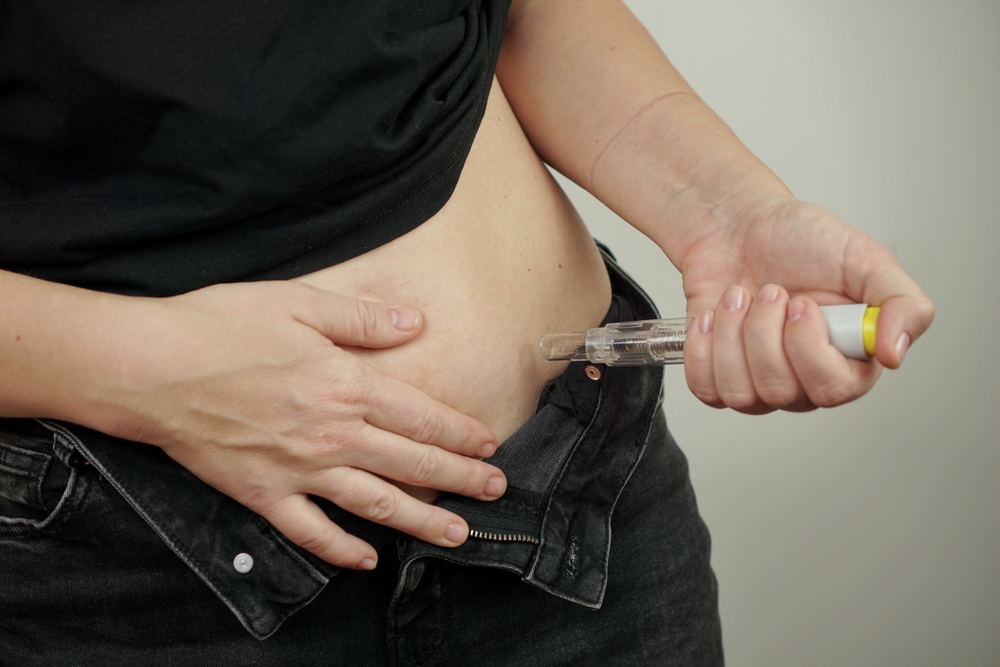
Lilly’s instructions are simple: change your tirzepatide injection site every week and don’t use the same spot twice in a row. You can inject into your stomach, the front of your thighs or, with help from someone else, the back of your upper arms. You can stay in the same body area as long as you pick a different spot within it. A rotation map makes this easy. Below are two ready-to-use plans, one using all three areas and one for people who inject on their own, plus how to track your sites and handle skin reactions.
Key takeaways
- Rotate your tirzepatide injection site every week, and never use the exact same spot twice in a row
- Approved areas are the stomach, front of the thighs and back of the upper arms
- Someone else should give injections in the back of the upper arm
- Stay at least 2 inches away from your belly button
- You can use the same body area two weeks in a row, as long as you choose a different spot in that area
- Avoid skin that’s bruised, tender, red, hard or scarred
Why rotating injection sites matters
Tirzepatide, sold as Zepbound and Mounjaro, is injected under the skin once a week. Using the same spot over and over can cause:
- Irritation, redness or tenderness
- Lipohypertrophy, a buildup of thickened or lumpy fatty tissue under the skin
- Less predictable absorption, since medicine injected into thickened tissue may not absorb as evenly
Rotating spreads your injections across healthy skin and gives each spot time to recover. Because tirzepatide is weekly, each area gets plenty of rest with a simple plan.
The approved injection areas
According to Lilly’s instructions for Zepbound:
| Area | Who can inject | Tips |
|---|---|---|
| Stomach (abdomen) | You or someone else | Stay at least 2 inches from the belly button |
| Front of the thighs | You or someone else | Use the middle third, between hip and knee |
| Back of the upper arms | Someone else | The fleshy area on the back of the arm |
Lilly’s vial instructions list the stomach and thighs, so check the instructions for your specific device. Your provider can help you choose the sites that work best for you. For more on how the areas compare, see where to inject tirzepatide for maximum effect.
Your tirzepatide rotation map
Think of your body as eight zones:
| Zone | Location |
|---|---|
| A1 | Stomach, upper left (your left) |
| A2 | Stomach, upper right |
| A3 | Stomach, lower left |
| A4 | Stomach, lower right |
| T1 | Left thigh, front middle third |
| T2 | Right thigh, front middle third |
| R1 | Left upper arm, back (helper needed) |
| R2 | Right upper arm, back (helper needed) |
Within each zone, move your injection spot about 1 inch from the last time you used it. Picture a small clock face in each zone and move one “hour” each time.
Plan 1: 8-week rotation using all three areas
Use this plan if someone can help with arm injections.
| Week | Zone |
|---|---|
| 1 | A1, stomach upper left |
| 2 | T2, right thigh |
| 3 | R1, left upper arm (helper) |
| 4 | A4, stomach lower right |
| 5 | T1, left thigh |
| 6 | R2, right upper arm (helper) |
| 7 | A2, stomach upper right |
| 8 | A3, stomach lower left |
After week 8, start again at week 1, but shift to a new spot about an inch from where you injected last time in each zone.
Plan 2: 6-week rotation for injecting on your own
Use this plan if you give yourself every injection and skip the arms.
| Week | Zone |
|---|---|
| 1 | A1, stomach upper left |
| 2 | T1, left thigh |
| 3 | A4, stomach lower right |
| 4 | T2, right thigh |
| 5 | A2, stomach upper right |
| 6 | A3, stomach lower left |
Each stomach zone gets 6 weeks of rest, and each thigh gets 3 weeks. If you only use your stomach, rotate through A1 to A4 in order and shift your spot within each quadrant every cycle.
Related tirzepatide care: weight loss prescription · pen injections explained · tirzepatide program
How to track your injection sites
A rotation map only works if you remember where you went last. Pick one method and stick with it:
- A phone note or calendar entry with the date, zone and any skin notes, such as “Mar 3, A1, slight redness”
- A printed body map taped inside a cabinet, where you mark each injection
- A reminder app that logs your weekly dose and site
Keep the same injection day each week. If your schedule changes, you can switch days, as long as there are at least 3 days (72 hours) between doses. If you miss a dose, follow the 4-day rule in what happens if you skip a tirzepatide dose.
Injection tips for each device
Tirzepatide comes in a few forms, and rotation works the same way for all of them:
- Single-dose pen: place it flat against the skin, unlock and press, and hold until it finishes. The needle is hidden.
- KwikPen: attach a new pen needle each time, dial your dose and hold the pen in place until the dose is complete.
- Single-dose vial: draw the dose with a new syringe and inject into the fatty tissue under the skin.
Before every injection:
- Wash your hands and clean the skin, then let it dry
- Check that the medicine is clear and colorless to slightly yellow, with no particles
- Check your device’s instructions about letting a refrigerated pen or vial sit at room temperature first, which some people find more comfortable
- Use a new needle every time and dispose of it in a sharps container
For a full walkthrough, see how to inject Zepbound correctly or our general step-by-step guide to injecting a weight loss pen.
Spots to avoid
Skip any area that is:
- Bruised, tender, red or swollen
- Hard, lumpy or thickened
- Scarred, including stretch marks and surgical scars
- Within 2 inches of your belly button
- Tattooed, if you have trouble judging the skin underneath
- Close to where you injected last week
Injection site reactions and what to do
Mild reactions are common with weekly injections and usually fade within a few days:
| Reaction | What helps |
|---|---|
| Redness or mild itching | A cool compress. Rotate to a different zone next week |
| Small bruise | Apply gentle pressure after injecting next time. It usually fades in a week |
| Tenderness | Inject into a fresh spot and use a new needle every time |
| A small lump under the skin | Avoid that spot until it’s gone. Check your rotation |
Contact your provider if a reaction is getting worse, spreads, feels hot, has pus or lasts more than a week. Get urgent care for signs of a serious allergic reaction, such as swelling of the face, lips or throat, trouble breathing or a widespread rash. Many of the same tips apply across GLP-1 medications. See how to treat an injection site reaction.
Common rotation mistakes
- Using the same spot every week. It’s the most common mistake and the main cause of lumpy, thickened skin.
- Injecting too close to last week’s spot. Move at least an inch away.
- Forgetting to track. Without a log, it’s easy to drift back to the same favorite spot.
- Pulling the pen away too soon. Hold until the device signals the dose is finished.
- Injecting near the belly button. Stay at least 2 inches away.
Injecting while traveling
Bring a simple version of your rotation plan with you, such as a note in your phone. If you’re traveling across time zones, keep your doses at least 3 days apart. See traveling with tirzepatide for storage and timing tips.
Using semaglutide instead?
The same principles apply to Wegovy and Ozempic, though their sites and schedules are slightly different. See our semaglutide injection rotation map.
The bottom line
Rotate your tirzepatide injection site every week across your stomach, thighs and, with help, the backs of your upper arms. Divide each area into zones, move about an inch within each zone every time, and keep a simple log. Plan 1 uses all eight zones over 8 weeks. Plan 2 covers six stomach and thigh zones if you inject on your own. Avoid bruised, scarred or lumpy skin, stay 2 inches from your belly button, and contact your provider if a reaction gets worse or doesn’t go away.
Have questions about injecting tirzepatide? Heally providers can walk you through technique, sites and side effects. Start with a weight loss consultation.
FAQ
Where can I inject tirzepatide?
In your stomach, the front of your thighs or the back of your upper arms. Lilly recommends that someone else give injections in the upper arm. Stay at least 2 inches away from your belly button.
Do I have to rotate tirzepatide injection sites?
Yes. Lilly’s instructions say to change your injection site with each weekly injection and not use the same site every time. Rotating helps prevent irritation and thickened, lumpy skin.
Can I inject tirzepatide in the same area every week?
You can use the same body area, such as your stomach, as long as you choose a different spot within it each time. Moving about an inch from your last spot, or switching quadrants, works well.
Does injection site affect how well tirzepatide works?
Lilly approves the stomach, thighs and upper arms, and you can choose whichever suits you. What matters most is injecting into healthy skin. Avoid lumpy or scarred areas, which may absorb medicine less evenly.
What should I do if I get a lump at my injection site?
Avoid that spot until it’s gone and check that you’re rotating properly. Small lumps usually fade. Contact your provider if a lump grows, becomes painful or hot, or doesn’t go away within a few weeks.
How far apart should my injection spots be?
Move at least an inch from your last injection within the same zone, and rotate between zones each week. Following a written rotation map makes this easy.
Sources
- Eli Lilly and Company. “Dosing, how to use and how to inject Zepbound (tirzepatide).” zepbound.lilly.com
- US Food and Drug Administration. “ZEPBOUND (tirzepatide) prescribing information and instructions for use.”
- Frid AH, et al. “New Insulin Delivery Recommendations.” Mayo Clinic Proceedings, 2016.
This article is for educational purposes only and is not a substitute for professional medical advice. Always follow the instructions for use that come with your medication and your provider’s guidance. Tirzepatide carries an FDA boxed warning about the risk of thyroid C-cell tumors. Do not use it if you or a family member has had medullary thyroid carcinoma or Multiple Endocrine Neoplasia syndrome type 2.